I was twenty, the beverage manager at the old Boston Garden, and I had just ordered forty-one cases of Budweiser instead of fourteen. My boss, whom I'll call Max, was a recent graduate of the Cornell School of Hotel Administration. He demanded to know how I could have made that mistake. With my back against the wall, I told him the truth: I'm dyslexic. I transposed the numbers. To my surprise, he didn’t know what dyslexia was. When I explained it, he looked at me with complete seriousness and asked, "Are you trying to tell me that you're kind of retarded?"
His question caught me off guard. Flustered, I told him no, it’s nothing like that, more like having bad eyesight. I assured him it wouldn’t happen again. Then I sat on a keg of beer in the rat-infested bowels of the Garden and made a decision that would run my life for decades. No one would ever know I was dyslexic again.
That word is in my book. I first heard it in elementary school, from kids teasing me about going to the "retard room." I heard it again from an Ivy League graduate in the basement of the Boston Garden. It is in the book because it was in my life. I didn't put it in for effect. I quoted it.
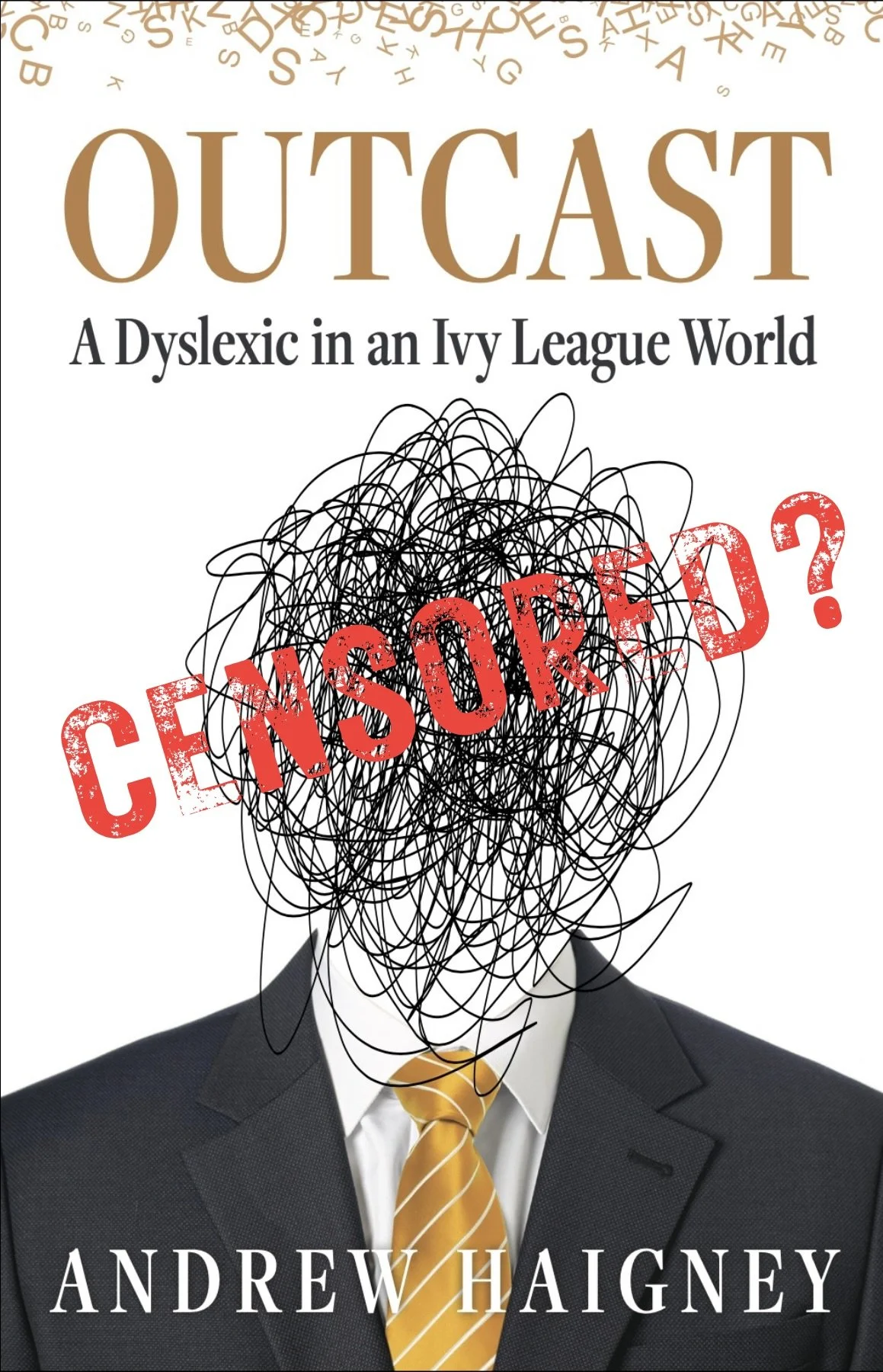
Seven weeks before my memoir, OUTCAST: A Dyslexic in an Ivy League World, was to be published, my publicity firm decided that word was a problem.
The Point of No Return
Seven weeks out is the point in a book launch where everything is committed. Review copies are getting circulated, media appearances are scheduled. There is no realistic way to engage a new firm and get them up to speed. Everyone in book publicity knows this.
The firm had my proposal, the full manuscript, and the marketing plan well in advance. We were weeks into a paid engagement. Nobody questioned the language. Then, at the moment when walking away would cost me the most, they pulled the rug out from under me.
First, they wanted the manuscript changed. When I appealed that the word appears only as quoted speech, a label the system applied to me and not one I was endorsing, they conceded the point. Then they moved to a second demand: a trigger warning on my media kit. That wasn’t up for debate.
Trigger Warning or Censorship?
It’s fair to ask if a disclaimer on a media kit is a form of censorship. On one hand, nothing gets cut. Every word stays in the book.
On the other hand, the warning has a meaningful impact on how the pitch lands. Before a producer or reviewer reads a single page, it tells them the author's account of his own childhood is hazardous material. For many outlets, that pitch is dead on arrival.
OUTCAST is a book about concealment. The decision I made sitting on that keg carried me to the institutional equity trading desk at Merrill Lynch, where I rose to Senior Vice President without a single college credit, surrounded by people with Max's pedigree, making sure none of them saw what I was hiding. I didn't overcome dyslexia. I hid it.
Sharing my journey with dyslexia wasn’t easy. Being asked to post a caution sign in front of it was the same old stigma in new packaging. Keep it out of sight. Make it comfortable for the people in the room.
The warning was not for readers, I trust my readers. Anyone picking up a memoir called OUTCAST knows what kind of book they are holding. On a call, the publicist on my account told me why she wanted it: she was worried about the career risk of being associated with my book. The caution sign wasn't for the readers. It was for her.
Paying the Price
I fired them. I would like to say it was an easy call, but I understood the consequences. I seriously considered pulling the plug on the entire project, walking away from a year and a half of hard work. In the end, I did what my dyslexia taught me – I decided to wing it.
The launch I had planned and budgeted for didn’t happen. There was no preorder campaign. There were only a handful of social media posts. The book came out on September 29th into near silence, and since then I have been doing the publicity myself, one letter and one pitch at a time.
I’d make the same decision again. At the risk of believing my own press clippings, an early reviewer compared the trading-floor chapters to Michael Lewis's Liar's Poker. Not bad for a guy who flunked English as a second language. I think the book will find its audience.
The Overlords of Publishing
If you are an author facing a similar choice, have your eyes wide open and understand the repercussions. The overlords of the publishing world have real leverage. Then decide whether your story is yours.
I spent most of my life letting institutions decide how much of me the room could handle. At this stage of the game, I am not about to bow down to a publicist.
They called me the R-word. I advised them on their investments. I'm not putting a warning label on either.